Behind the scenes with the University of Hawai’i football team
October 22, 2026 by Jocelyn Grams, Arizona Lutheran Academy

This article's authors and photographer attend Arizona Lutheran Academy and are members of the AIA SID program.
On Friday, October 9, 2026, the University of Hawaiʻi Rainbow Warriors football team—with 74 players and 54 personnel—stepped onto our Arizona Lutheran Academy football field for a pregame practice prior to their matchup against Arizona State University. Three AZ Lutheran seniors who are members of the AIA Sports Information Director (SID) team—Jocelyn Grams, Reagan Indahl, and Delaney Humbert—had the opportunity to interview players, coaches, and team personnel. Fellow SID member Levi Hartzell documented the practice through photography. This article was written jointly by Jocelyn, Reagan, and Delaney, with photos by Levi.
 (Levi Hartzell photo/AZPreps365)Traveling across the country for an away game requires more than preparing players for competition. Behind every team is a support system of family members, coaches, and staff members who help make each trip possible. Through these interviews, it became clear that the Rainbow Warriors’ experience in Arizona involved not only the challenges of travel but also the relationships and teamwork that support the program.
Sherry Chang, wife of University of Hawaiʻi head football coach Timmy Chang, shared the rewards and challenges of traveling with the team while being interviewed by SID member Jocelyn Grams. Despite the stress, she said the relationships built with players and their families make the experience worthwhile. “It’s a really stressful job, but the fun part is getting to know our boys. These are our kids almost. Getting to know them, getting to travel to all these places, making lifelong friends and family. That’s probably the best part, the people,” she said. Although she is not on the field, Sherry supports both her husband and the team throughout the season. “We care so much. As a head coach, you’re responsible for so many people and so many moving parts. So anything that falls on him, falls on me too because that’s my partner. Whatever he bears, I think I bear too,” she explained.
The players themselves must also adjust to the demands of traveling long distances to compete. For starting quarterback Micah Alejado, one of the most difficult aspects of traveling from Hawaiʻi to Arizona was adjusting to the time difference. “I think the hardest thing is the jet lag, the stuff you don’t see. We’re leaving at 7am our time and landing at 10pm last night. One of the hardest things is the time difference, catching up on the time and the jet lag, the legs are heavy and everything is tired.” Jocelyn Grams interviews Alejado (Levi Hartzell photo/AZPreps365)As one of the farthest-traveling teams in college football, the University of Hawaiʻi faces unique challenges throughout its season. Long flights, time-zone changes, and differences in elevation can make preparation more demanding, requiring players to adjust quickly before taking the field. Despite these challenges, Alejado remained focused on the opportunity to compete against ASU. When asked what he was most looking forward to about the matchup, he emphasized the excitement of playing at a high level and having the opportunity to showcase his abilities on national television. He ends his interview with these final thoughts to interviewer Jocelyn Grams: “I think the environment is fun and the opportunities to go play at a high level school and have an opportunity to be on national television and get an opportunity to go show out and do what you do.”
When Jocelyn Grams talked to starting running back DeVon Rice, he said he viewed the trip to Arizona as more than an opportunity to play football. Returning to the mainland allowed him to reconnect with family and experience familiar surroundings. “Honestly, it's being back on the mainland. I'm from Vegas and I got family out here. It's good to be back on the land. The weather is familiar and it feels like home.” Rice, along with other members of the team, attended Bishop Gorman High School in Las Vegas. Returning to the mainland gave him the opportunity to be closer to home and see family members who would attend the game. Like Alejado, Rice was also excited about the opportunity to compete against a major opponent and showcase his abilities on a national stage. Having family in attendance made the matchup even more meaningful. “We have a big opponent. We get to go on stage and show what we got against the world and everybody. We’re going to be on TV, and we got a lot of family coming to the game, so it’s going to be a good time. It’s exciting.”
Against Arizona State, Rice carried the ball six times for a total of 28 yards. His experience highlighted another side of away-game travel: while the journey can be physically demanding, it can also provide players with opportunities to reconnect with family and compete in front of familiar faces.
 Delaney Humbert and Jocelyn Grams interview the equipment manager (Jenni Petersen photo/AZ Lutheran Digital Media teacher and photographer)While the players focus on preparing for competition, a significant amount of work takes place before the team even reaches the field. Equipment and logistics staff members play an essential role in coordinating the details of away-game travel, ensuring that players have everything they need to perform. Delaney Humbert interviewed Adonis Hentz, the team’s equipment manager, who helps oversee equipment-related responsibilities, from fixing helmets and preparing uniforms to ensuring players have the cleats, shoes, and apparel they need. Preparation begins as early as Monday, when the staff starts packing uniforms and additional equipment for different weather conditions. Adonis expressed gratitude for the support of his student managers and his boss, Al Ginoza, who has more than 30 years of experience in equipment management. Reflecting on the guidance he receives, Adonis said, “He coaches me up a lot and gets me up to speed on how I should be doing things and stuff. I’m so very fortunate in what I’m doing is that.”
Adonis’s work demonstrates how much preparation is required before the team can take the field. However, organizing equipment is only one part of coordinating a trip across the Pacific Ocean. Moving the team and its supplies from Hawaiʻi to Arizona requires additional planning and coordination.
Reagan Indahl started her interview with Reyn Shiraishi. Reyn, the team’s logistics manager, explained that equipment is loaded onto a truck on Wednesday before the team flies out on Thursday. Hawaiian Airlines helps accommodate the team’s travel needs and is also one of the team’s jersey sponsors. Coordinating transportation is essential, particularly when hundreds of pieces of equipment and medical supplies must travel with the team. Despite the planning involved, the flight itself remains one of the biggest challenges. Reyn explained how time spent traveling affects both the schedule and the players. “Time spent on a plane could be spent somewhere else. It takes a toll on their bodies as well.” His perspective connects directly to the challenges Alejado described regarding jet lag and physical fatigue.
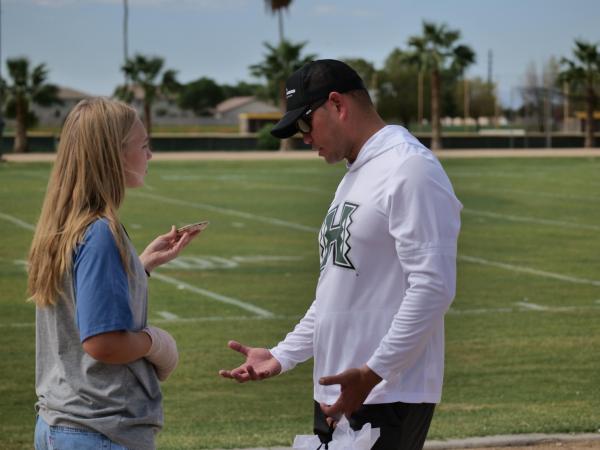 Reagan Indahl interviews head coach, Timmy Chang (Levi Hartzell photo/AZPreps365)Head coach Timmy Chang, also interviewed by Reagan Indahl, and his staff must account for these challenges when preparing the team. With away games requiring travel across different time zones and climates, preparation extends beyond reviewing plays and practicing on the field. The coaching staff must also consider sleep schedules, workouts, and the physical demands placed on athletes. When asked how the team adjusts to changes in time zones and climate, Chang explained that preparation involves carefully considering several factors. “It is a total adjustment for us…the way we prepared, the way we sleep... the way we work out... it's all thought out…we use data to help measure our athletes and try to put them in the best position as we do going through a different climate change and a different time zone.”
Chang also emphasized the importance of collaboration among the coaching and support staff. He relies on the strength and conditioning coaches, director of operations, and general manager to help develop plans and make decisions that prepare the players for the demands of travel.
Beyond physical preparation, Chang also highlighted the importance of creating a supportive team environment. Throughout the interviews, the relationships on the team were said to be a key to their program. Chang emphasized the importance of strong relationships, highlighting mentorship and compassion as key parts of helping athletes grow on and off the field. “Really pouring into me and my staff, really being the supportive father figure to mentor our young ones as they're growing from that young adulthood into, really, life…trying to be great role models for them, but do it with compassion and love.” His comments reflect the same sense of connection that Sherry described when discussing the players as being almost like family. Together, their perspectives show how the program’s culture extends beyond football, with coaches and their families working to support players throughout their college experience.
That sense of support can also be seen in the individual journeys of the athletes. For kicker Sean Olvera-Harle, who was interviewed by Delaney Humbert, the path to playing football at the collegiate level began with a different sport. He started his athletic journey as a soccer player. After taking a year off, he decided to become active again and began kicking at a junior college. He discovered that he enjoyed it and eventually made his way to Hawaiʻi. Although traveling away from home can be challenging, Olvera-Harle explained that Hawaiʻi has become a comfortable place for him. “It reminds me of back home, California. I don’t get homesick too much, but it's definitely the beaches in Hawai’i and all the people are a lot nicer here.”
During the off-season, Olvera-Harle focuses on kicking, weightlifting, and maintaining a healthy diet. When offering advice to younger athletes, he emphasized that success depends on more than natural ability. “Don’t believe it takes just natural bar and talent. You can achieve anything through hard work and through God.” His advice reflects the dedication required to compete at the collegiate level. Whether adjusting to a new environment, managing the demands of travel, or working to improve athletic performance, players must remain committed to their goals throughout the season.
As the interviews revealed, every member of the team faces different challenges and brings a unique perspective to the experience of college football. For starting linebacker Jamih Otis, the matchup against ASU represented another opportunity to trust his preparation and rely on his faith.
When Reagan Indahl asked about the challenges the team might face in their game at ASU, Otis acknowledged the strength of both teams and emphasized the importance of trusting God's plan. “It's a long game… they have great players, we have great players; whatever God’s going to put us through tomorrow so you know we're just trusting in God's plan.” Despite the preparation, travel, and excitement leading up to the matchup, the game ultimately ended with Arizona State defeating the Rainbow Warriors 30–12.
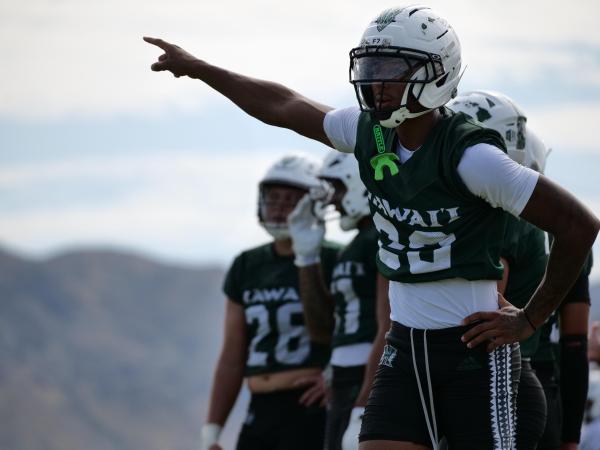
Although the Rainbow Warriors left Arizona without a victory, their visit to our campus was a fantastic experience for us—and highlighted the dedication, teamwork, and preparation required to run a college football program. Beyond the game, we had the chance to see how the people bring a team together to compete at the collegiate level. AZ Lutheran students filled the bleachers to watch the team practice during lunch (Levi Hartzell photo/AZPreps365)
 (Levi Hartzell photo/AZPreps365)
 (Levi Hartzell photo/AZPreps365)
 (Levi Hartzell photo/AZPreps365)
 (Levi Hartzell photo/AZPreps365)
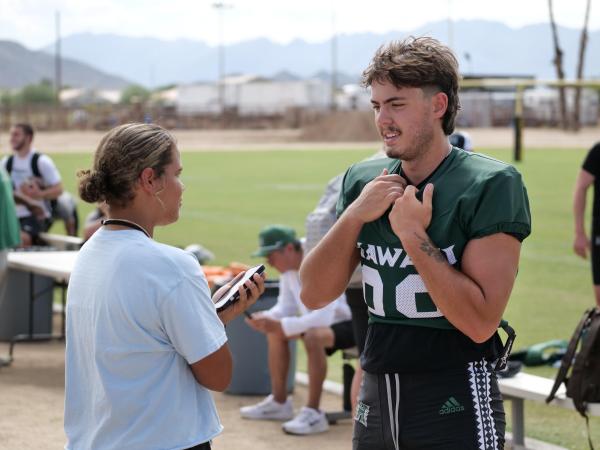
 Players were generous with their time and more than happy to answer questions. (Levi Hartzell photo/AZPreps365)